How to Automate the Self Storage Customer Journey?
The complete guide to automating every stage, from first enquiry to access code, so your team only steps in when a human is genuinely needed.

Written by: Jack Colemanzo
Data validated by: Storeganise team
Published: 2026-06-17
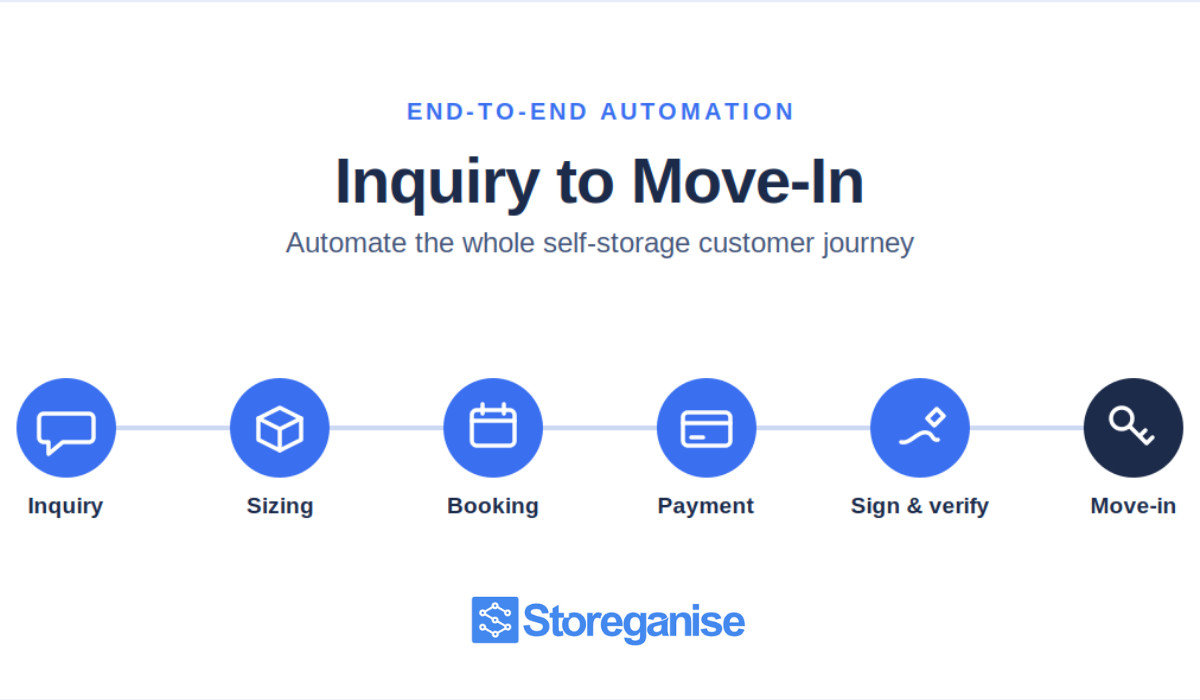
There's a version of your self-storage business where a customer finds you at 11pm, gets their unit-size question answered, picks a space, signs the contract, pays, and walks in with an access code the next morning, and your team touches none of it.
That's not a pitch for some far-off future. It's how a growing number of operators already run, and the gap between them and everyone else is widening fast. The operators still fielding every enquiry by phone, sizing units by guesswork, and chasing signatures by email aren't just working harder, they're converting worse and scaling slower.
This is the most complete guide we have on closing that gap. We'll walk the entire customer journey (inquiry, sizing, booking, payment, contract, verification, move-in) and show exactly what to automate at each stage, including where AI now does work that used to need a person. Think of it as the practical companion to The Self-Storage Operator's AI Playbook; the Playbook covers the full AI strategy, and this article shows how it plays out across one continuous flow.
Let's take it stage by stage.
Stage 1: The inquiry, answer instantly or lose the lead
The journey starts the moment someone lands on your website, and it's where most bookings quietly die.
A prospect shows up with one or two questions, Do you have a 10x10? What's the price? Can I get in after hours?, and if there's no immediate answer, a big share of them simply leave. Your team never even knows they were there. This is brutal after hours and on weekends, which is exactly when a lot of storage browsing happens.
What to automate: instant, 24/7 responses to facility, pricing, availability and promotion questions. This is the job of an AI Booking Assistant, a conversational tool that answers in plain language around the clock, with no staff required. It pulls from your live data, so customers never see outdated pricing or availability, and if it genuinely can't help, it routes them to your contact details rather than leaving them stranded.
The principle here is simple and it underpins the whole journey: the faster you answer, the more you convert. An unanswered question at 9pm is a competitor's booking by 9am.
Stage 2: Sizing the unit, kill the guesswork
The single biggest stall point in self-storage booking is the question "will my stuff actually fit?"
Customers don't think in square feet. They think in sofas, boxes, and bikes. Faced with a list of unit sizes and a vague size guide, plenty of them freeze, decide to "measure later," and never come back. Others over-book a unit that's too big (and feel ripped off later) or under-book one that's too small (and have a bad move-in day).
What to automate: unit-size recommendation. A modern AI Booking Assistant lets a customer type a quick list ("sofa, 10 boxes, bike, TV") or upload a photo of their belongings, then recommends the right size based on your real-time availability. The guesswork disappears, and so does the most common reason people abandon mid-booking. Booking confidence goes up; size-related drop-off goes down.
Stage 3: The booking, under a minute on any device
Once a customer knows what they want, the booking itself has to be effortless. Every extra field, every "call us to reserve," every clunky mobile form is a place to lose them.
The benchmark now is genuinely fast: a customer should be able to go from choosing a unit to a confirmed booking in under a minute, on a phone, at midnight, without speaking to anyone.
What to automate: the full self-service reservation. A modern customer booking portal gives prospects an optimized, mobile-friendly checkout that's available 24/7, so they book on their time, not your office hours. The less friction in this step, the more interested customers you actually convert, which is the entire point of maximising your website's conversion rate.
Stage 4: Payment, collected instantly and automatically
A booking isn't really a booking until the money's in. Manual payment-taking (invoices sent by hand, cards keyed in over the phone) is slow, error-prone, and a conversion killer at the exact moment a customer is ready to commit.
What to automate: payment capture at the point of booking, and recurring billing after. Integrate your preferred gateway (Stripe, Mollie, Fortis and others are all supported) so deposits and first payments are taken instantly as part of the booking flow, and ongoing rent collects automatically on schedule. Done properly, automated billing reclaims a large chunk of the admin time operators lose to invoicing and payment chasing every month.
Stage 5: The contract and ID, signed and verified without the back-and-forth
Historically this is where a smooth online journey collapsed into a manual mess: print the lease, email it, wait for a signature, ask for ID, follow up when it doesn't arrive.
What to automate: digital signing and identity verification, inline. Send leases for e-signature as part of the same flow, and collect ID or proof of address through custom upload fields, or enable automated ID checks via Stripe Identity for fast, secure verification without anyone reviewing documents by hand. The customer signs and verifies in the same sitting they booked in, and you get a clean, compliant record with zero chasing.
Stage 6: Move-in, access code issued, hands-off
The finish line: the customer needs to actually get into their unit. The old way (coordinating a time, meeting them on site, handing over a key) doesn't scale and doesn't suit a customer who booked at midnight.
What to automate: access. With the booking, payment, contract and verification all complete, the system can issue an access code automatically, so the customer can move in on their own schedule. Connect your access-control hardware and the whole thing runs without a site visit, the foundation of running a facility that operates with minimal staff on the ground, which is the heart of self-storage automation as a whole.
That's the full front-end journey: inquiry to move-in, contactless, around the clock, with your team out of the loop unless a human is genuinely needed.
The other half: automating your side of the journey
Everything above automates the customer's experience. But there's a second layer most operators miss, automating your own visibility into and control over that journey.
This is where two tools earn their place.
Reusable AI prompts for your team. The Playbook's prompt cheat sheet is the easiest starting point: a set of ready-made prompts your whole team can use for drafting tenant communications, reviewing competitor pricing, writing follow-ups, and handling the repetitive writing work that surrounds the journey. No special tooling, just better use of the ChatGPT or Claude account you probably already have.
The AI Connector, for the data behind the journey. Once customers are flowing through the funnel, you need to know what's working. The Storeganise AI Connector links your account to ChatGPT or Claude so you can ask, in plain English: "How many bookings came in over the last 30 days, through which sites, and how does that compare to last month?" or "Where am I losing customers between inquiry and move-in?" It turns the journey from a black box into something you can interrogate any time, the back-office counterpart to the customer-facing automation above.
If the front-end tools win and keep customers, the Connector is how you understand and improve the whole machine. We dig into the difference between these customer-facing and operator-facing tools in AI connectors vs AI chatbots.
Start where your biggest leak is
You don't have to automate all six stages on day one. The smart move is to find your biggest leak first.
If prospects bounce after hours, start with the AI Booking Assistant. If they stall on sizing, that same tool fixes it. If bookings are slow or manual, prioritise the customer portal and payment automation. If you're already converting well but flying blind on the numbers, the AI Connector is your next step. Most operators find that fixing the single weakest stage pays for the whole effort, and once one domino falls, the rest follow naturally.
The bottom line
The self-storage customer journey (inquiry, sizing, booking, payment, contract, verification, move-in) can now run end to end with almost no manual work. AI answers and sizes at the front, a self-service portal books and bills in the middle, automated signing and access close it out, and behind the scenes, AI tools give your team reusable prompts and let you query the whole funnel in plain English.
The operators who automate this journey convert more leads, lose fewer to after-hours and sizing friction, and scale without piling on staff. The ones who don't are competing with one hand tied behind their back.
For the complete strategy behind all of it, read The Self-Storage Operator's AI Playbook, or book a demo and we'll map your current journey and show you exactly where the automation wins are.
Share this article
Jack Colemanzo
Jack Colemanzo is the Head of Sales at Storeganise, based in Barcelona. With a strong background in the technology industry, spanning software development, sales management, and team leadership, Jack is a catalyst for growth and a builder of positive team culture.
View bio