How to future-proof your storage business with the right tech stack
A real operator's story about building a tech stack with no lock-in, full control, and room to grow.

Written by: Jack Colemanzo
Data validated by: Storeganise team
Published: 2026-07-07
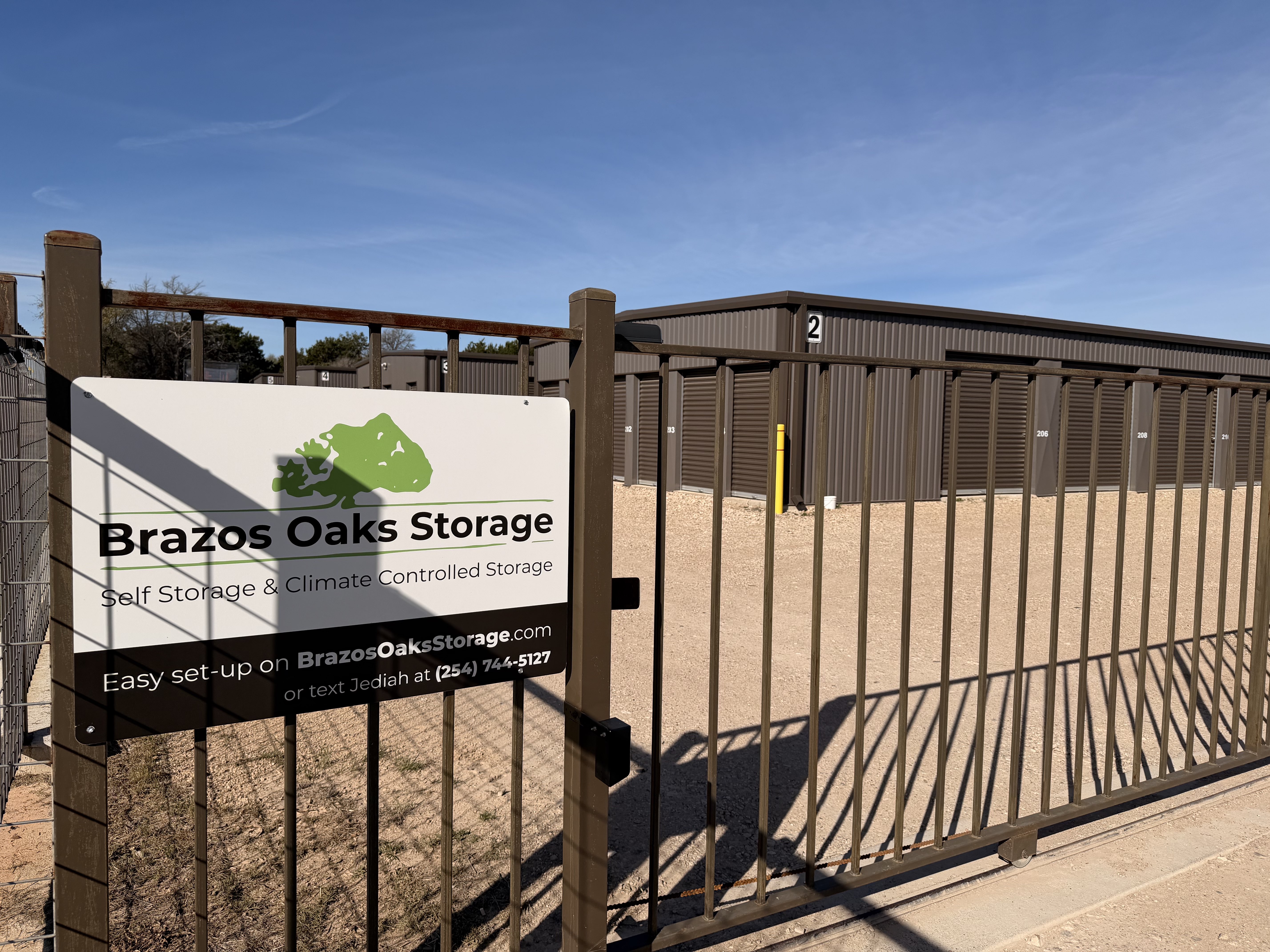
Company Information
- Company Name: Brazos Oaks Storage
- Head Office: Waco, TX
-
Website:
https://www.brazosoaksstorage.com/
Introduction
When Jed Owen started looking for self-storage software, he didn't have an operations team, a tech consultant, or even a peer to ask.
What he had was a spreadsheet, one facility, and a determination not to make a decision he'd regret.
A couple of years later, Jed runs three self-storage facilities with no on-site staff, managing everything remotely from his phone and computer. He's built his own gate control system, automated his customer communications, and is already thinking about revenue management and AI-powered reporting.
His story isn't about having a big budget or a development team. It's about choosing the right foundation from the start.
The flexibility of having the API is just that, whatever you dream up to customize to your particular thing, you can do it. – Jed Owen
Start with the Right Criteria
When Jed and his brother began evaluating software, they went in with a blank slate. No industry contacts, no prior FMS experience, just a methodical approach to figuring out what actually mattered.
They signed up for demos across the board. His brother came at it from a technical angle. Jed came at it from operations, he was going to be the one in it every day.
Three things rose to the top:
- Open API access. Not a partial integration layer, a full, open API. Jed wanted to own his data and have the freedom to connect whatever tools he needed. "There are very few softwares that have a full open API," he says. "That majorly narrows down the options."
- Ease of use. It had to work out of the box, without a specialist to set it up. Jed needed software simple enough for a part-time office manager in her 60s to use confidently, and robust enough to handle three facilities as the portfolio grew.
- Value. Not the cheapest, the best return for what they were building. That means avoiding platforms that charge as much for add-ons as the core software itself.
Download the Self-Storage Operator's AI Playbook
How to make AI work for your self-storage business. Including the industry-first way to talk to your self-storage software.
Don't Underestimate the Data Migration
Jed's clearest piece of advice for any operator onboarding a new facility? Get your data clean before you go live.
On his first site, the transition was smooth. The history existed on a spreadsheet, and it was just a matter of walking the office manager through the new flows.
The second site was a different story. The previous owner had run it from two banker boxes of handwritten contracts. No spreadsheet. No digital records. Jed had to call each tenant individually to figure out who was still renting, who had paid a year in advance, and who was a year behind.
If I was to do it again, I would have waited to transition to the software until I had clean data. Clean data in makes your life so much easier. – Jed Owen
It's a lesson that applies to any acquisition: sort the data first, then flip the switch.
Build on a Platform You Actually Own
One of the things Jed talks about most is control, specifically, what you give up when you choose software that locks you in.
He's watched peers get caught out by platforms that get acquired, change pricing, or restrict access to the tools that surround them.
"A lot of people feel like the rug has been pulled out from under them with a lot of leading softwares." – Jed Owen
His approach is the opposite. With Storeganise as his core system of record, Jed has built a tech stack where he owns as much as possible:
- Workflow automation: He uses N8N, self-hosted, for workflow automation, the same kind of logic you'd build in Zapier, but running on his own infrastructure.
- Gate control: He built his own gate control system using Ubiquiti hardware, tied together with custom middleware via the Storeganise API. Each tenant has a unique gate code. When a payment fails, the code is automatically revoked. When they pay, it's reinstated immediately, no manual intervention, no extra software subscription.
- Payment processing: He owns his payment processor, keeping another layer of control inside the business rather than handing it to a third party.
"The flexibility of having the API is just that, whatever you dream up to customize to your particular thing, you can do it." – Jed Owen
Use AI to Build, Not Just to Automate
Jed is already using AI tools in practical ways — and not just to save time on emails.
He used AI to build the website for his third facility. He used it to write the middleware connecting his gate system to Storeganise. His next project is using the Storeganise AI connector to get a clearer picture across all three sites, flagging customers who need attention, surfacing growth opportunities, and eventually feeding into a proper revenue management process.
"It's easy to miss little things when you're dealing with hundreds of customers. I want to be able to give a report of how we're doing, where the opportunity is, what needs attention." – Jed Owen
For Jed, AI isn't a feature, it's a capability that compounds. And the only way to take advantage of it is to be on a platform that stays open enough to connect to it.
Flexibility Across Sites Is an Underrated Advantage
One thing Jed didn't expect when he started building a portfolio: how much it matters that your software works with whatever access system, payment setup, or legacy infrastructure comes with an acquired site.
"If you go buy a site tomorrow that's on OpenTech, you can still use it — you don't have to rip it out. It allows you to be flexible with your approach, try different things at different sites." – Jed Owen
That flexibility isn't just convenient — it lowers the risk of every acquisition. You're not forced into a costly rip-and-replace just to get a new site onto your platform. You can integrate what's there, run it alongside your existing stack, and modernise on your own timeline.
What Jed Would Tell Operators Looking to Modernise
After two years, a second evaluation of the full market, and three facilities running on the same platform, Jed's view is clear:
"I'm convinced that Storeganise is best positioned for the future of software for storage. Because of the flexibility, the API, because it's lightweight, robust, easy to use. You own your data." – Jed Owen
His advice to operators considering a change:
- Take the software evaluation seriously — demo everything, compare features, and think about where you want to be in five years, not just today.
- Prioritise open access over feature lists. The features you need today will change. The ability to build what you need won't.
- Don't rush the migration. Clean data and a phased rollout will save you weeks of headache.
- Find software your whole team can use — not just the tech-forward people, but the part-time manager who just needs a reliable, simple interface.
Conclusion: Future-Proof from the Start
The industry is changing. Automation, AI, and integrated tech stacks are becoming table stakes, not differentiators. The operators who future-proof now will be the ones who have the flexibility to move fast when it matters.
The key takeaway? The software decision you make at the start shapes what you can build later. Jed chose a platform that gave him control, flexibility, open API access, and the ability to automate on his own terms.
Want to see how Storeganise fits your operation? Book a demo or explore our open API documentation.