Product overview
Get a complete view of the tools that power your business

Get a complete view of the tools that power your business
Let customers book and manage storage with ease

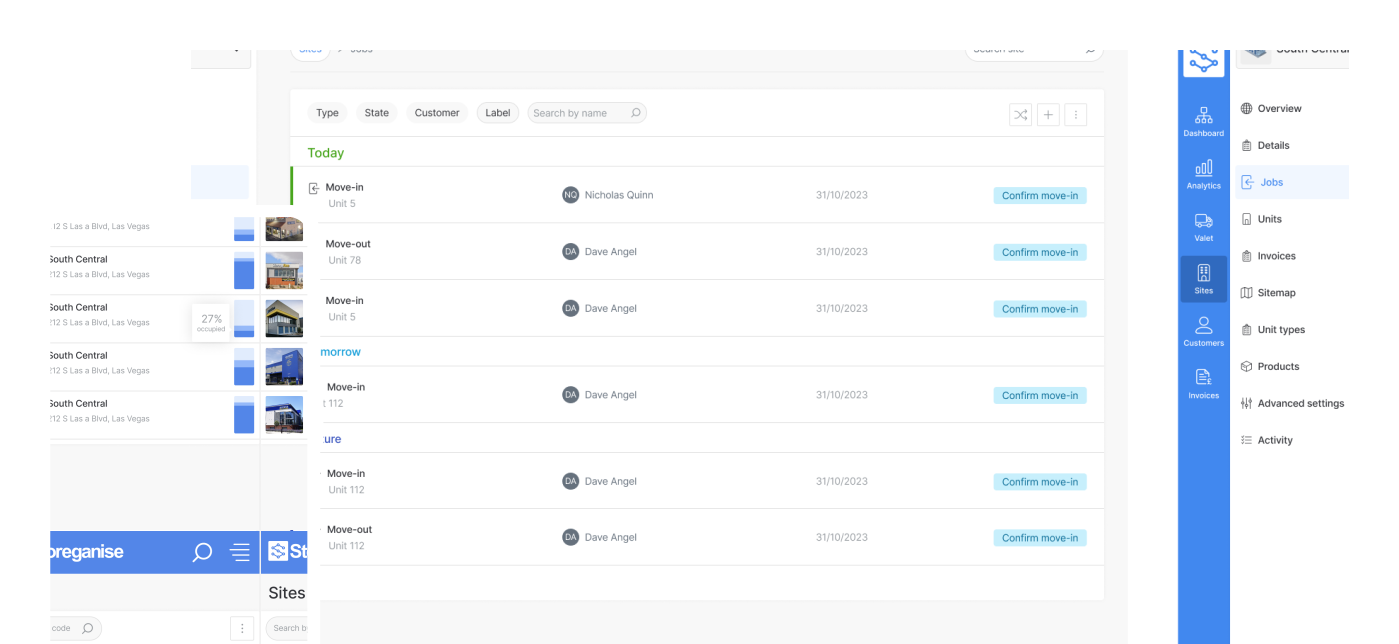
Manage your entire business in one place
Attract new customers with a website built for self-storage

Extend your business logic with endless integrations
Some operators are paying £17,000 a year more than they need to

Jack Colemanzo
2026-05-11
Export your last 90 days of transactions by payment type and we'll model the real numbers, including whether Stripe's invoicing fees are being applied.
No obligation
Works with any current PMS setup
Results in 48 hours
A 1,000-customer UK storage portfolio, £120 average monthly charge. Run the numbers across two different software setups and you get a £1,416/month gap, £16,992 a year, in what operators pay to collect the same revenue.
Most of that gap has nothing to do with which payment processor you use. It comes from where invoices live.
When your software uses a payment provider to generate and manage invoices, not just to take payment, those providers typically charge extra for that. Those fees are published on each provider's pricing page, but they rarely come up in software demos or vendor comparisons.
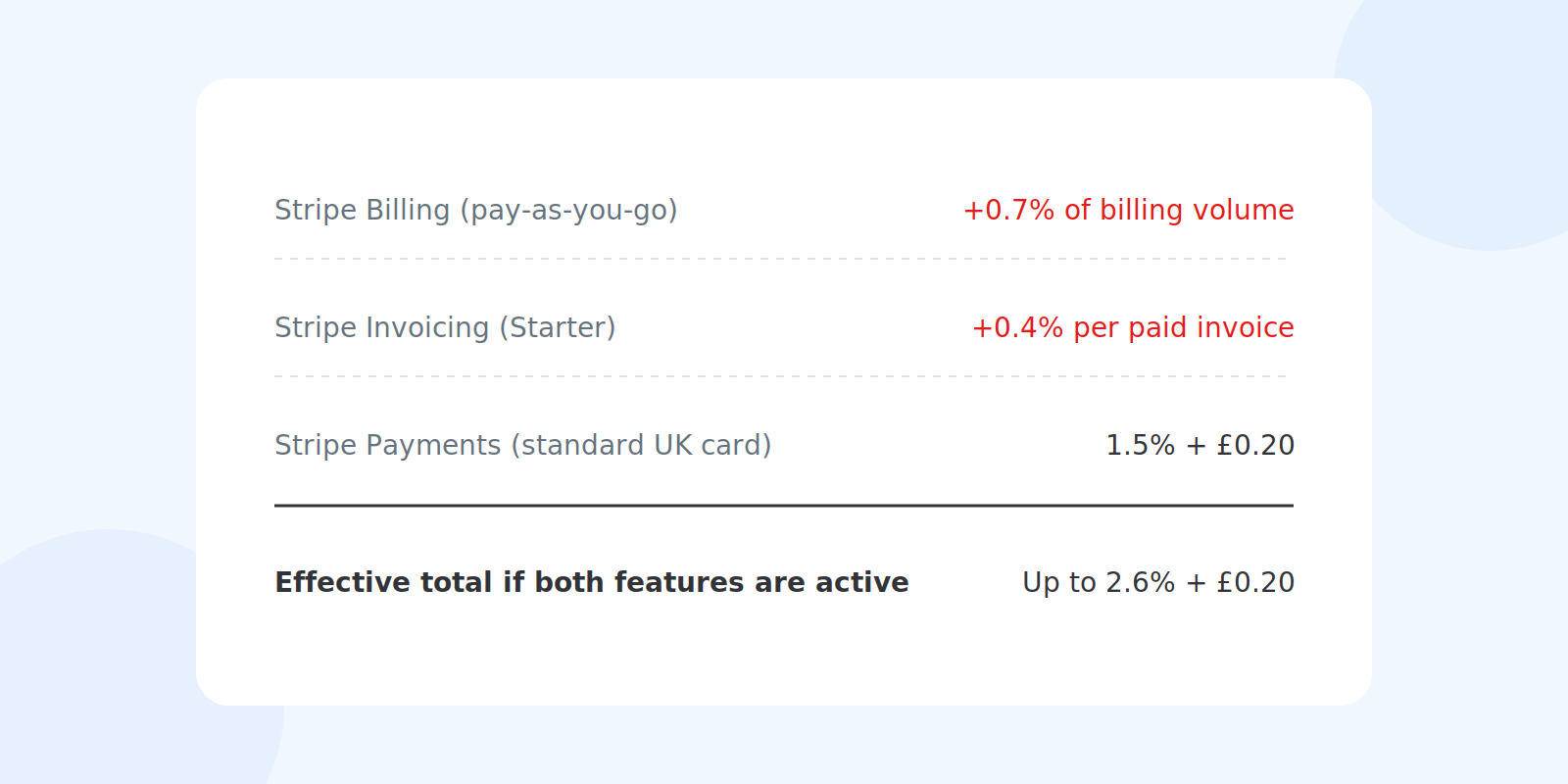
Stripe is the most common provider in UK self-storage, so we'll use its published rates as the worked example. The structure is similar across providers that bundle invoicing into their payment product:
Most providers that offer an invoicing product apply that fee on top of payment processing, not inside it. When both features are active, that's an extra ~1.1% on every pound collected, before standard payment fees even apply.
The key question: Does your software generate invoices itself, using the payment provider only to take the payment? Or does the payment provider handle the invoicing too? The answer determines whether you're paying the standard payment rate, or that rate plus invoicing fees.
You don't need to dig into your software settings to get a sense of this. Look at your last month's payment gateway dashboard: divide your total fees by your total volume. For a standard UK domestic card mix, a typical payment processor's published rate lands around 1.67% (Stripe's UK published baseline, as a reference point). If you're consistently seeing 2%+, that's a sign the billing and invoicing fees are being charged on top, and it's worth investigating.
Some platforms in the European market use Stripe for far more than just payment processing, with invoicing workflows also tightly coupled to the payment gateway itself. Features such as payment recovery, reconciliation, and automatic invoice generation are often powered directly through Stripe.
While some providers may offer discounted transaction rates through broader partnership agreements, additional costs can still arise from Stripe’s own billing and invoicing products, depending on how the platform is configured.
For example, Kinnovis states that recurring invoices, one-time charges, and upfront payments are all handled “through our Stripe integration.” The distinction matters: through Stripe, not simply processed by Stripe.
If Stripe is also being used for invoicing and billing, it’s worth understanding how this impacts financial reporting. In many cases, the source of truth for end-of-month reporting may already reflect transaction fees deducted directly within Stripe-generated invoices. As a result, operators should carefully review how the PMS accounts for monthly revenue compared to the figures shown within Stripe itself.
This can become particularly difficult to reconcile when batch invoices are involved, making it harder to clearly identify true gross revenue versus net revenue after transaction fees. The complexity often becomes even more noticeable when integrating natively with accounting platforms such as QuickBooks and Xero, where reconciliation accuracy between the PMS, payment gateway, and accounting system becomes increasingly important.
It’s worth asking any PMS vendor directly: “Does your platform generate invoices itself, or does that happen inside the payment provider?” It’s a simple question, and the answer will help clarify whether invoicing functionality — and any associated fees — sits within the PMS or the payment gateway.
For context, here are Stripe's published standard UK rates for the payment types most common in self-storage, verified directly from Stripe's UK pricing page (March 2026). These are the baseline any operator on a standard Stripe plan is working from.
Storeganise customers can choose from multiple integrated payment providers, including Stripe and Mollie with great processing rates. Get in touch to discuss processor options and pricing for your portfolio size.
Here's how the numbers stack up in practice. Same portfolio, same customers, same payments — two different software setups.
Assumptions: 1,000 customers, £120 average monthly charge, 60% domestic cards / 30% Bacs Direct Debit / 10% cash.
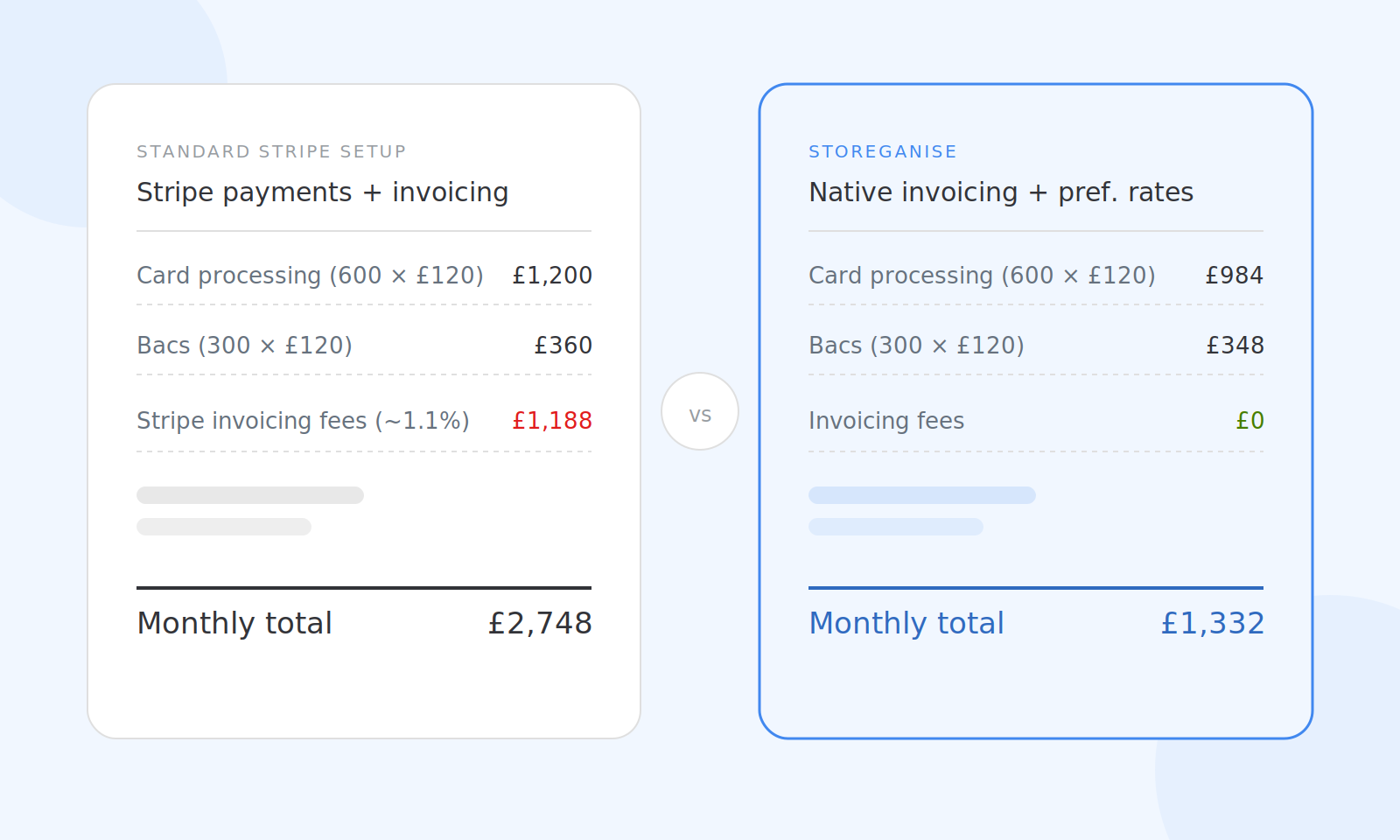
Of the £1,416/month difference, £1,188 comes from removing provider-side invoicing fees and £228 from lower payment rates. The invoicing question is the bigger number by far.
Same payment mix (60% domestic card / 30% Bacs / 10% cash), £120 avg. ticket. Provider invoicing fees modelled at ~1.1% of processed volume.
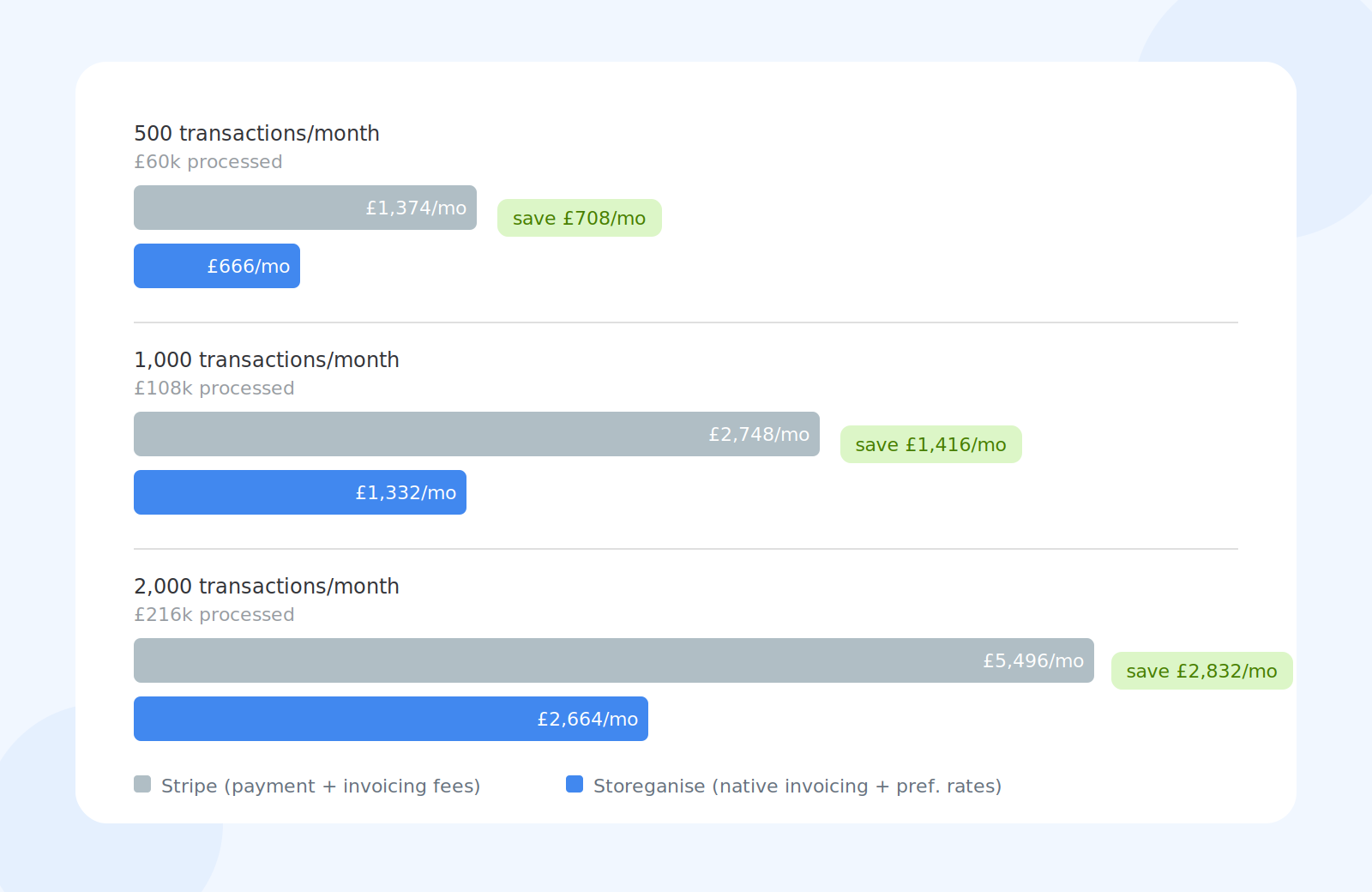
The cost difference is the easy part to quantify. There are practical day-to-day consequences too when your software relies its payment provider for invoicing.
Your data is split across two systems. Invoice history, arrears, and payment status live partly in your PMS and partly in the payment provider's dashboard. Running clean portfolio reports means reconciling both.
Your team needs to know two platforms. If failed payment retries and follow-ups are configured inside the payment provider, your staff need access and training there too — not just your PMS.
Switching later becomes harder. Customer records and invoice history stored inside any single payment provider create a dependency that makes it more difficult to move to a different setup down the line.
In Storeganise, invoices are created and managed inside the platform on a schedule. Your chosen payment provider (Stripe, Mollie, or another supported processor) handles the actual payment — and the result syncs back. The payment provider stays a payment tool. Your PMS stays the source of truth.
This model uses a clean domestic UK scenario. Real portfolios are more varied.
Stripe's Bacs cap (£4) only kicks in above a £400 average ticket — most storage operators won't hit it. Commercial cards, EU cards, and currency conversion attract higher rates — your actual customer mix will affect the real numbers. The ~1.1% invoicing figure (modelled on Stripe's published Billing + Invoicing rates) applies when both the Billing and Invoicing products are active; if only one is in use, the extra cost is lower, but still there. Most providers, including Stripe and Mollie, offer custom pricing at volume. The rates shown here are standard published figures.
Sources: Stripe is used as the worked example throughout because of its prevalence among UK self-storage PMS platforms. The same fee pattern applies to other payment providers whose products bundle invoicing with payment processing. Stripe UK pricing page - accessed 18 March 2026. Storeganise preferential rates from Storeganise rate card (contact sales for current figures). Scenario model: 1,000 monthly transactions, £120 average ticket, 60% domestic consumer card / 30% Bacs / 10% cash, no FX or international cards. Stripe invoicing fee modelled at 1.1% (Billing 0.7% + Invoicing 0.4%) on processed volume. No chargebacks, refunds, or failed payment retries included. Published rates subject to change. Stora and Kinnovis are referenced solely based on their own publicly available help centre documentation and product pages.
Export your last 90 days of Stripe transactions and we'll model your real fees, including whether Stripe's invoicing layer is adding to your costs. We'll send you the breakdown either way.

Jack Colemanzo is the Head of Sales at Storeganise, based in Barcelona. With a strong background in the technology industry, spanning software development, sales management, and team leadership, Jack is a catalyst for growth and a builder of positive team culture.
View bio