What Self Storage Dynamic Pricing Actually Does to Your Revenue
Self storage dynamic pricing explained: how the triggers work, when to use it, what it earns. Includes a worked 200-unit model and copyable rate rules.

Written by: Jack Colemanzo
Data validated by: Storeganise team
Published: 2026-9-30
Updated: 2026-9-30
A facility sitting at 97% occupancy looks like a success story. More often it is a pricing failure that nobody has noticed yet. Self storage dynamic pricing is the practice of moving your advertised rates with demand rather than setting them once a year and hoping, and it is the main reason the large REITs earn more per square foot than the independent down the road. This guide covers how the triggers work, what the gain actually looks like on a 200-unit facility, and the situations where you should leave rates alone. We operate in more than 50 countries across self storage, container and valet models, so it also covers the markets where the usual advice does not apply.
Key takeaways
- Dynamic pricing moves your street rate for new inquiries. ECRI moves rates for tenants already in place. They are separate systems, and running them as one is the commonest mistake operators make.
- Sustained occupancy above roughly 95% is a pricing signal, not a win. You are leaving money on units you cannot replace.
- On the worked model below, the gain came mostly from unit sizes in short supply, not from raising everything.
- Guardrails matter more than the algorithm. Caps, floors and exclusion rules are what prevent the reputational problem operators worry about.
- If your market has no rate-shopping data, occupancy-triggered rules still work. Competitor scraping does not.
What dynamic pricing means in self storage
Dynamic pricing means your advertised rate for a unit type changes automatically in response to how much of that unit type you have left, how quickly it is moving, and what the market around you is charging. A 10x10 with eight units vacant is priced differently from the same 10x10 with one unit vacant.
That is the whole mechanism. Everything else is detail about which signals you feed it and how far you let it move.
The comparison people reach for is airline seats, and it is close enough to be useful. The seat does not change, but the price rises as inventory thins and the departure date approaches. Storage has the same shape with a slower clock: the unit does not change, but the price should rise as the last few of that size go and fall when you are sitting on empty space in January.
Where the analogy breaks down matters more than where it holds. An airline seat expires on departure. A storage unit does not expire, but every month it sits empty is revenue you can never recover. The bigger difference is that an airline prices a single transaction, while you are pricing the start of a tenancy that may run for years. That is why the move-in rate and the long-run rate are different problems, and why dynamic pricing on its own is only half a revenue strategy.
Large publicly traded operators have used these algorithms for years. Smaller operators only started adopting them widely in the last few years, which is recent enough that the practice is still unfamiliar to a lot of independents (Inside Self-Storage).
Why 97% occupancy is a warning sign
Ask most operators how the site is doing and they will tell you the occupancy figure. It is the wrong number to lead with.
Physical occupancy tells you how much of your space is full. Economic occupancy tells you what you are actually collecting against what the space could collect at current market rates. A site can be 97% physically occupied and 84% economically occupied because half the tenants are on rates set three years ago and the remaining vacancies are in the sizes nobody wants.
| Physical occupancy | Economic occupancy | |
|---|---|---|
| What it measures | Units or square feet filled | Revenue collected vs revenue potential at market rate |
| What it misses | What you are charging | Nothing, which is why it is the harder number |
| What high looks like | 95% and above | Rarely above 90% in practice |
| What it tells you to do | Very little | Where the gap between your rates and the market sits |
The practical rule: if a unit type has been above 95% occupied for three months or more and you have not moved the rate, the rate is too low. You are turning away inquiries you could have converted at a higher price, and you have no inventory left to sell to the people who would have paid it.
The inverse is the part operators skip. If a unit type has been below 80% for three months, that rate is also wrong, and holding it steady out of pride is costing you more than a discount would.
The two levers: street rate and ECRI
This is where most implementations go wrong, so it is worth being precise.
Street rate is what you advertise to someone who does not yet rent from you. It is public, it is compared against competitors, and it can move weekly without anyone objecting, because nobody has a prior expectation of what your 10x10 costs.
ECRI, the existing customer rate increase, is what you charge someone already storing with you. It is private, it arrives as a letter or an email, and it carries an expectation set by whatever they have been paying. It moves on a schedule, not on a trigger.
| Street rate | ECRI | |
|---|---|---|
| Applies to | New inquiries | Tenants already in place |
| Changes | Weekly or daily, automatically | On a schedule, commonly every 9 to 18 months |
| Driven by | Vacancy, velocity, competitor rates | Tenure, current rate vs market, unit type |
| Visible to | Everyone, including competitors | One tenant at a time |
| Risk if wrong | Lost conversions | Move-outs and complaints |
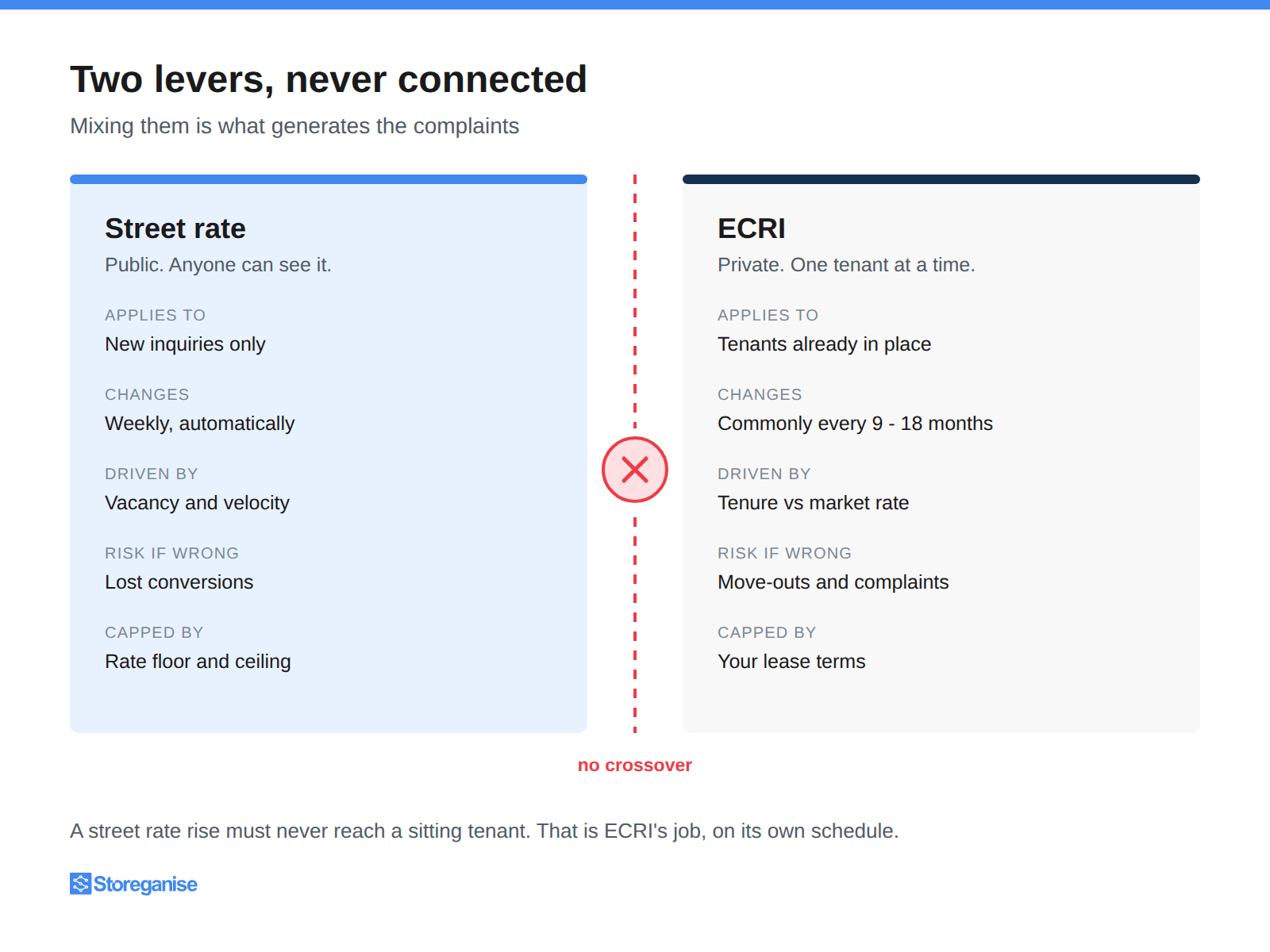
Running these as one system produces the failure operators actually fear. If your algorithm raises the street rate 12% because you are down to two 10x10s, and the same logic pushes that increase out to sitting tenants the same week, you have just handed a rate rise to people whose behavior had nothing to do with the shortage. That is the version of dynamic pricing that generates complaints, and it is avoidable.
Keep them separate. Let the street rate move freely inside its guardrails. Let ECRI run on its own cadence with its own rules, informed by market rates but not triggered by them.
Our guides on handling a self storage price increase and increasing prices without angering customers cover the ECRI side in more detail. The rest of this piece is about the street rate.
What it actually earns: a 200-unit worked example
Nothing on this topic is published with real numbers, so here is a full model. These are modeled figures on stated assumptions, not reported results from a specific site. Substitute your own inputs and the shape should hold.
The facility
- 200 units: 50 small (5x5), 120 standard (10x10), 30 large (10x20)
- Starting rates: $65, $135, $210 per month
- Weighted average rate: $128.75 per unit per month
- Seasonal occupancy running from 86% in January to a 96% peak in August
The two scenarios
Static: rates held flat, one across-the-board 5% ECRI applied in month 7. This is how most independent sites run.
Dynamic: street rates move on occupancy triggers by unit type, plus staged ECRI on the same 5% budget but applied by tenure rather than to everyone at once. Occupancy runs about one point lower at peak, because higher street rates do suppress some conversions.
| Month | Occ. static | Occ. dynamic | Avg rate static | Avg rate dynamic | Revenue static | Revenue dynamic | Delta |
|---|---|---|---|---|---|---|---|
| 1 | 86% | 86% | $128.75 | $129 | $22,145 | $22,145 | $0 |
| 2 | 86% | 86% | $128.75 | $129 | $22,145 | $22,145 | $0 |
| 3 | 88% | 88% | $128.75 | $131 | $22,660 | $23,056 | +$396 |
| 4 | 90% | 89% | $128.75 | $134 | $23,175 | $23,852 | +$677 |
| 5 | 92% | 91% | $128.75 | $136 | $23,690 | $24,752 | +$1,062 |
| 6 | 94% | 93% | $128.75 | $138 | $24,205 | $25,668 | +$1,463 |
| 7 | 95% | 94% | $135.19 | $143 | $25,686 | $26,884 | +$1,198 |
| 8 | 96% | 94% | $135.19 | $148 | $25,956 | $27,824 | +$1,868 |
| 9 | 94% | 93% | $135.19 | $147 | $25,416 | $27,342 | +$1,926 |
| 10 | 91% | 90% | $135.19 | $144 | $24,605 | $25,920 | +$1,315 |
| 11 | 88% | 88% | $135.19 | $142 | $23,793 | $24,992 | +$1,199 |
| 12 | 87% | 87% | $135.19 | $141 | $23,523 | $24,534 | +$1,011 |
| Year | 90.6% | 89.9% | $286,999 | $299,114 | +$12,115 |
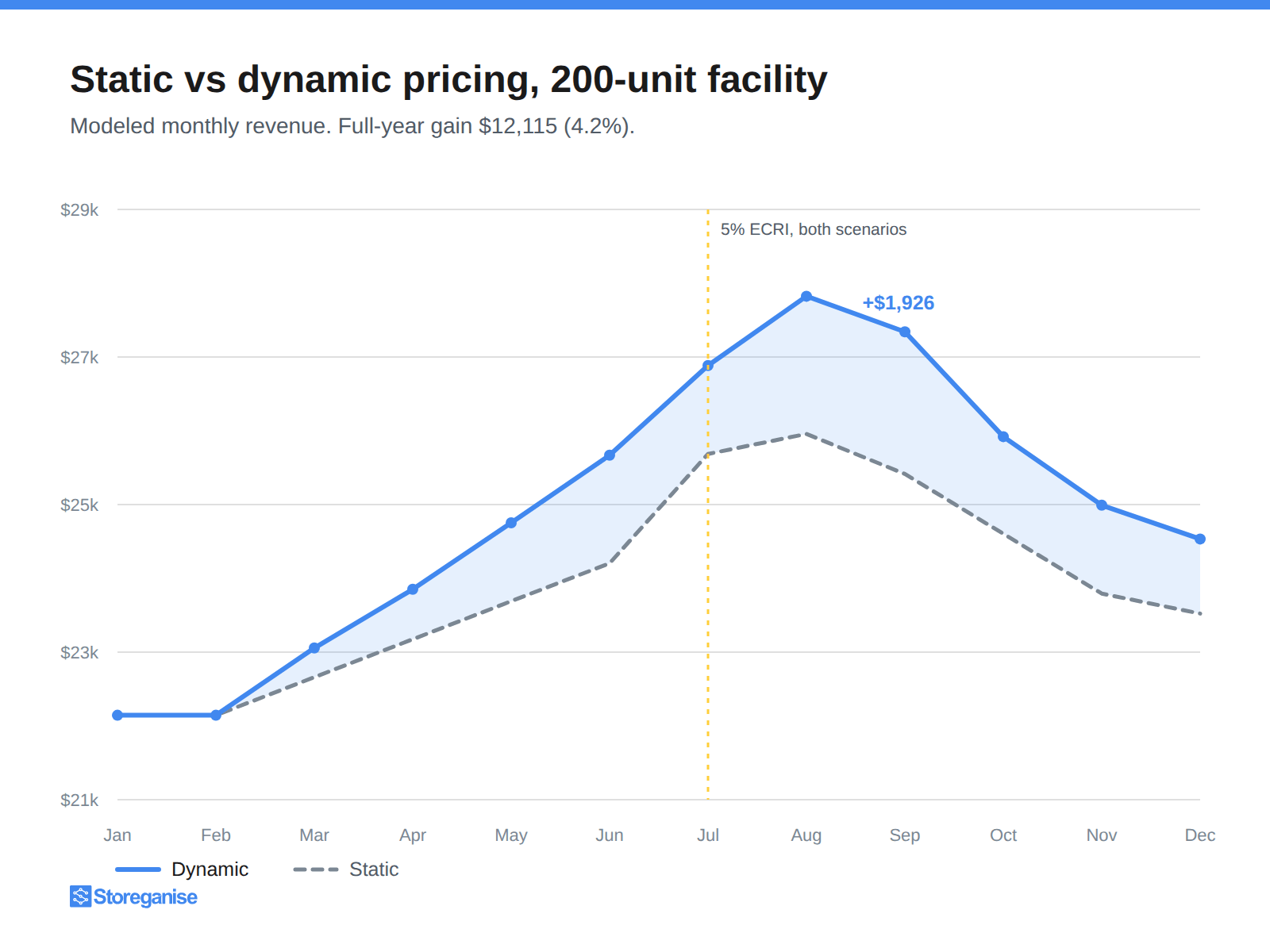
What the model says
The annual gain is $12,115, or 4.2%. RevPAF, revenue per available unit per month, moves from $119.58 to $124.63.
Three things are worth pulling out of that.
The dynamic site finished the year with lower average occupancy and higher revenue. If you manage to an occupancy target, dynamic pricing will look like it is failing.
Nothing happens in months one and two. Dynamic pricing does not rescue a soft market, it captures a tight one. Most of the gain lands between months six and ten, when inventory is thin.
The 4.2% is on revenue, and it drops almost entirely to the bottom line because the cost of the rate change is close to zero. Against a typical net operating margin, a 4.2% revenue gain is a considerably larger percentage gain in NOI, which is also why it moves valuation on a cap rate basis.
Assumptions you should challenge before trusting this: the one-point occupancy cost of higher street rates is a judgment, not a measurement, and it will be larger in an oversupplied market. The seasonal curve is a northern-hemisphere pattern. The 5% ECRI budget is deliberately identical across both scenarios so the comparison isolates the street rate effect.
Setting your trigger rules
Start simple. A rules table you understand beats an algorithm you do not, and you can always add signals later.
| Occupancy for that unit type | Action on street rate | Guardrail |
|---|---|---|
| Below 80% for 30 days | Reduce up to 10%, or add a first-month concession | Never below your rate floor |
| 80 to 89% | Hold | Review monthly |
| 90 to 94% | Increase 3 to 5% | Maximum one change per 14 days |
| 95% and above for 14 days | Increase 5 to 10% | Maximum one change per 14 days, cap at rate ceiling |
| Last unit of a size | Increase up to 15% | Cap at rate ceiling, flag for manual review |
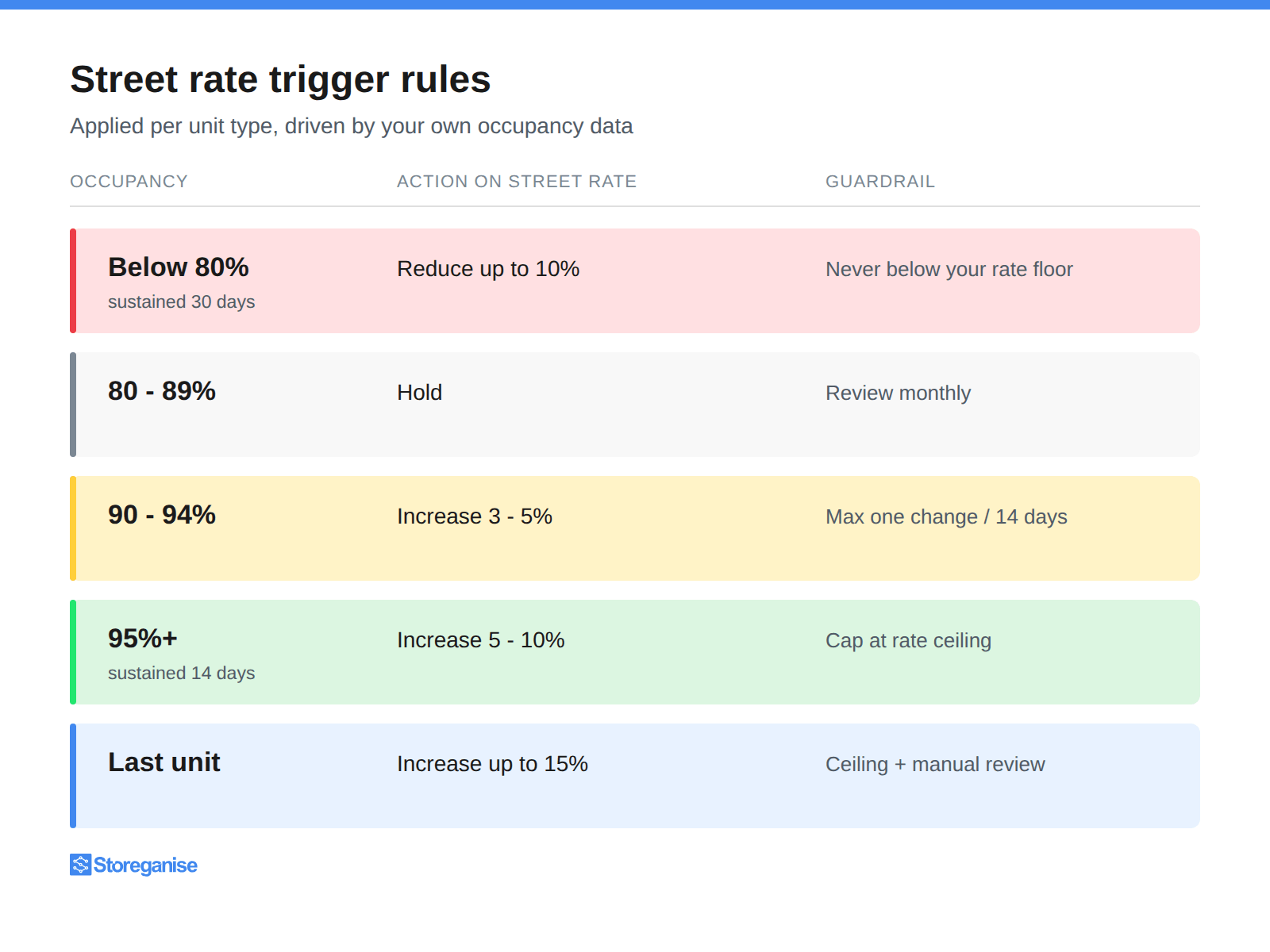
Three parameters do most of the work:
Rate floor. The number below which you will not go regardless of vacancy. Set it from your cost per square foot plus target margin, not from what the competitor down the road is doing.
Rate ceiling. The number above which the algorithm stops and asks a human. This is the single control that prevents the headline problem, where an automated system prices a storage unit at an absurd number because inventory hit zero. The concert ticketing industry learned this publicly when dynamic pricing pushed some seats to $4,000 against an average ticket price of around $200, and the backlash was about the algorithm being unsupervised rather than about variable pricing itself (Inside Self-Storage).
Change frequency. Cap it where you can. A rate that moves daily is visible to anyone watching your site and reads as unstable. Fortnightly is enough to capture most of the gain. Not every platform offers a frequency limit as a setting, and where yours does not, the practical control is how many occupancy bands you define. Four bands produce far fewer changes than twelve.
Storeganise splits this across two features. Dynamic Pricing moves street rates automatically, in real time, the moment a unit type crosses an occupancy threshold you have set, and it is included on every plan. Automated Rent Increases is a separate add-on covering ECRI, with its own interval, percentage, notice period and review period, so increases to sitting tenants can be checked or cancelled before notice goes out. You can see how both fit with the rest of the platform on our self storage software page.
Which units to apply it to, and which to leave alone
Dynamic pricing works on inventory that is genuinely scarce and genuinely substitutable. That is a narrower set than most operators assume.
Good candidates. Your highest-demand size, usually the 10x10. Climate-controlled units where you have a limited number. Ground-floor and drive-up units, which command a premium that most static rate cards under-price. Any size where you routinely turn inquiries away.
Poor candidates. Sizes you have too many of, where the answer is a unit mix problem rather than a pricing problem. Your very largest units, which often have a handful of possible tenants in the catchment and where a rate move changes nothing. Units already discounted under a long-term or corporate agreement.
Leave alone entirely. Anything during lease-up. A new site needs occupancy before it needs rate optimization, and running dynamic pricing during lease-up will slow your fill rate for a gain you cannot yet afford. Wait until the site is stable, then switch it on.
A related point on unit mix: if dynamic pricing keeps pushing one size up and another down, that is telling you something about your build. Worth reading alongside tracking the right business metrics.
Guardrails: caps, floors and the fairness problem
Some operators refuse dynamic pricing on principle. At least one software vendor in this market has deliberately left the feature out of their product, arguing that it conflicts with fairness and customer trust.
The objection deserves a better answer than dismissal, because the underlying concern is real. A tenant who discovers that the person in the identical unit next door pays less will not be reassured by an explanation of yield management.
The answer is that variable pricing is not the problem. Unsupervised variable pricing is. Every industry that prices dynamically and has kept customer trust does the same few things:
- A ceiling you have decided on. Some platforms expose this as a dedicated setting. Where they do not, the highest rule you configure becomes your ceiling in practice, so set that top band deliberately rather than leaving it open-ended.
- Rate lock on move-in. The rate a tenant signs at is the rate they pay for a defined period, set by you and stated in the lease. This single rule removes most of the objection, because it means the fluctuating number is an offer, not a bill.
- No retroactive application. A street rate rise never reaches a sitting tenant. That is ECRI's job and it runs on its own schedule.
- Exclusions. Long-term tenants, corporate accounts, and anyone in the middle of a dispute come out of the automation entirely.
- A human review step on any change above a set threshold.
There is also a commercial reason to hold this line rather than a purely ethical one. Rate-driven move-outs are expensive. A tenant who leaves over a badly handled increase costs you the vacancy period, the cleaning, the marketing and the discount you offer the next person. The arithmetic on a 10% increase that triggers a move-out is worse than the arithmetic on a 5% increase that does not.
Regulatory attention is the other consideration. Pricing that reads as exploitative during a cost-of-living squeeze attracts scrutiny, and the industry has been warned about this in print. A ceiling is cheap insurance.
Pricing without market data
Nearly everything written about self storage dynamic pricing assumes you can see competitor rates. In the US and UK that is a fair assumption. In a lot of markets it is not, and in some storage models it does not apply at all.
Markets with thin comparable data. Across much of continental Europe, Asia, Latin America and the Middle East, there is no rate-scraping service covering your catchment, and the two or three competitors near you may not publish rates online at all. Competitor-driven pricing is unavailable to you.
Occupancy-driven pricing is not. Every trigger in the table above works from your own data: how full each unit type is, how fast it is moving, how long units sit vacant. That is the majority of the signal. Competitor rates mainly tell you where your floor and ceiling should sit, and you can establish those once a year with manual research rather than continuously.
Valet and mobile storage. There is no street rate to shop, because the customer is buying a service rather than a unit: collection, storage by the box or by volume, and return on demand. Demand signals still exist, but they are different. Your constraint is warehouse space by volume and van capacity on a given day, not units of a given size. Dynamic pricing in a valet model usually means pricing the collection slot and the volume tier rather than the storage itself, and the fairness rules matter more because the customer has no way to compare.
Container and portable storage. Inventory is genuinely fixed and genuinely visible, which makes occupancy triggers work well. The complication is that a container site can often add stock faster than a fixed building can, so a sustained high-occupancy signal might be telling you to buy containers rather than raise rates.
If you run more than one of these models, the practical answer is separate rule sets rather than one algorithm, because the constraint you are pricing against is different in each.
What to look for in a pricing tool
Most self storage management platforms now offer something in this area, and the labels are not consistent. Questions worth asking:
- Does it separate street rate from ECRI? If the answer is vague, that is the answer.
- Can you set a floor and a ceiling per unit type, not just globally?
- Does it recommend or does it apply? Recommendation with one-click approval suits most independents better than full automation.
- What is the change frequency, and can you cap it?
- What data does it use? Your own occupancy only, or external market rates as well. Ask what happens in a market where the external data is thin.
- Does it write back to your website and booking flow automatically, or does someone update the rate card by hand? A pricing engine that does not reach the customer-facing rate is a spreadsheet with extra steps.
- Can you exclude tenants and unit types from automation?
- What does the audit trail look like? You will eventually need to explain a specific rate on a specific day.
Frequently asked questions
What is dynamic pricing in self storage?
Dynamic pricing in self storage means your advertised rate for each unit type changes automatically based on how many of that size are vacant, how quickly they are renting, and local market conditions. It applies to new inquiries rather than existing tenants, and it typically moves rates up when inventory is scarce and down when space sits empty.
Is dynamic pricing legal?
Yes, in the markets where self storage operates commercially. Varying prices by demand is standard practice across airlines, hotels and car rental. The area to watch is consumer protection rather than pricing law: advertised rates must be honored, increases to existing tenants must follow your lease terms and any state notice requirements, and pricing that appears exploitative attracts regulatory attention.
Does dynamic pricing upset existing tenants?
It should never reach them. Dynamic pricing moves the street rate for new inquiries only. Existing tenants change rates through a scheduled ECRI on its own cadence. Most complaints attributed to dynamic pricing are actually caused by operators applying street rate movements retroactively to sitting tenants, which is avoidable.
What is the difference between dynamic pricing and ECRI?
Dynamic pricing adjusts advertised rates for new customers automatically, driven by vacancy and demand, and can change weekly. ECRI is a scheduled increase applied to tenants already in place, commonly every nine to eighteen months, driven by tenure and the gap between their rate and current market rate. They are separate systems with separate rules.
How much revenue does dynamic pricing add?
Published figures are scarce and most vendor claims are unsubstantiated. The model in this article produces a 4.2% annual revenue gain on a 200-unit facility, on stated assumptions. The gain concentrates in peak months and in scarce unit types, and it comes with slightly lower average occupancy, so measure it on revenue per available unit rather than occupancy.
Do I need special software for dynamic pricing?
For a single site with a handful of unit types you can run the rules manually with a monthly occupancy review. Past two or three sites, or past roughly 200 units, manual becomes unreliable and the delay between the demand signal and the rate change eats most of the gain. At that point a platform that updates the public rate automatically earns its cost.