Self Storage AI in 2026: What's Real, Hype, and Working
Cut through the conference-booth noise. An honest look at which self-storage AI is genuinely working in 2026, and which is just marketing.

Written by: Jack Colemanzo
Data validated by: Storeganise team
Published: 2026-06-15
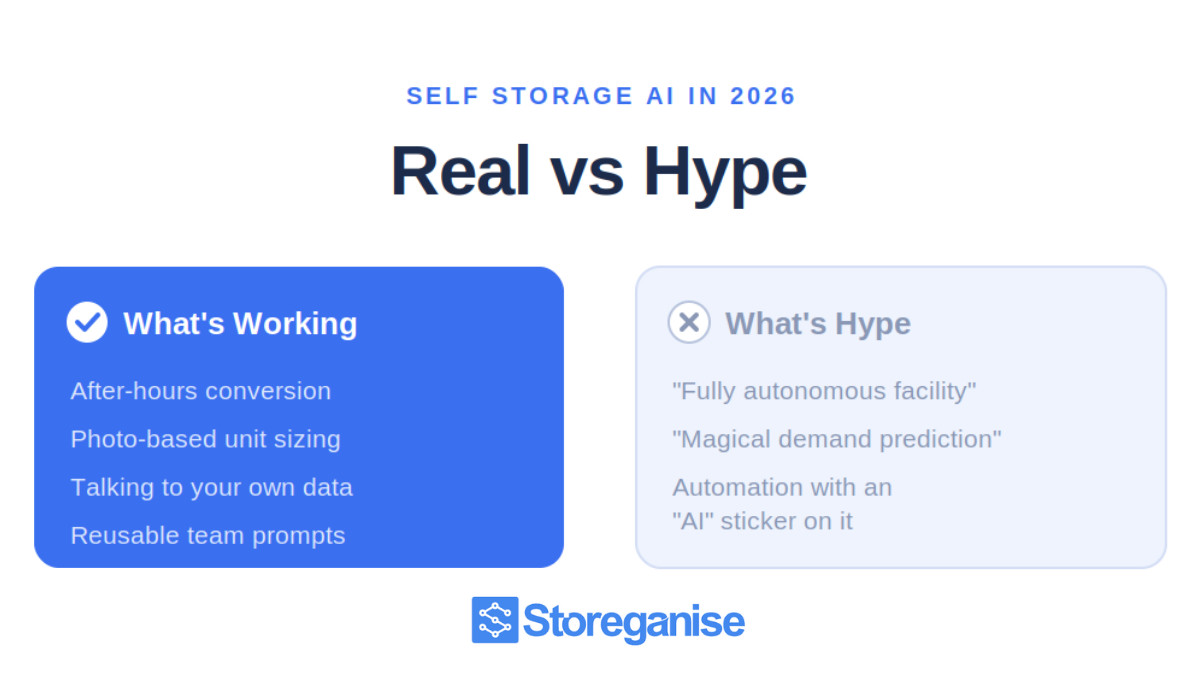
If you've been to a self-storage conference in the last year, you already know the script. Every booth has "AI" on the banner. Every demo has an "AI-powered" something. Every vendor will tell you that you're falling behind if you're not using it.
Some of that is true. A lot of it is noise. And for an operator just trying to run a good business, it's genuinely hard to tell which is which, because the hype and the substance are being sold in the same breath, by the same people, using the same word.
So here's an honest attempt to sort it out. No vendor cheerleading, no doom-mongering about robots taking over the storage industry. Just a straight look at what self-storage AI actually is in 2026: what's real, what's overblown, and what's genuinely moving the needle for operators right now.
First, why "AI" got so noisy
It's worth understanding why the term lost its meaning before we try to recover it.
When a technology gets hot, the label gets slapped on everything. "AI" in self storage now covers everything from a genuinely capable tool that can analyse your entire portfolio, down to a basic automated email that's been "AI" in name only for fifteen years. When one word stretches that far, it stops telling you anything.
That's the real problem operators face. It's not that AI in self storage is fake, plenty of it is very real. It's that the signal is buried under marketing, and the only way through is to ignore the label and ask a better question of any tool: what specific work does this actually do, and is that work worth paying for?
Let's apply that question to the things you're most likely to hear about.
What's hype (or at least oversold)
Some of the loudest claims deserve a raised eyebrow.
"AI will run your whole facility autonomously." Not in any meaningful sense, not yet. AI can automate large parts of specific workflows (answering enquiries, sizing units, analysing data) but the idea of a hands-off facility that needs no human judgement is marketing, not reality. The useful version of this is narrower and more honest: AI removes repetitive work so your team spends time on the decisions that actually need them.
"Our AI predicts the future of your business." Be skeptical of grand predictive claims. Forecasting demand and pricing from clean data is real and useful; a black box that promises to foresee your occupancy with magical precision is usually overselling a fairly ordinary model. Ask what data it uses and how, and the hype tends to evaporate.
"It's AI" (when it's just automation). This is the most common sleight of hand. A scheduled rent increase or an automated payment reminder is genuinely valuable, but it's automation, and it's been around for years. Rebadging it as "AI" doesn't make it more powerful; it just muddies your evaluation. Useful, yes. New and intelligent, no.
None of this means these tools are bad. It means the framing is inflated, and inflated framing makes it harder to judge what you're actually buying.
What's real
Strip away the overselling and there's a solid core of AI that genuinely works in self storage today.
Conversational AI that talks to customers. This is real and it works. An AI tool that answers prospect questions in plain language, 24/7, and helps them through to a booking is no longer experimental, operators are using it now to capture leads that used to leak away after hours. It understands natural language and context, which is what separates it from the scripted chatbots of the past.
AI that sizes a unit from a photo. Genuinely clever and genuinely useful. A customer uploads a photo of their belongings or lists what they're storing, and AI recommends the right unit size against live availability. It solves the single most common reason people stall mid-booking ("will my stuff fit?") and it's a concrete, working application, not a someday promise.
AI that analyses your operational data on demand. Also real, and arguably the most underrated. Instead of waiting on pre-built reports, operators are connecting AI tools to their live data and asking questions directly: occupancy trends, pricing comparisons, revenue per square foot, where customers drop off. More on this below, because it's the development most likely to genuinely change how you work.
AI as a day-to-day assistant. The least flashy but most widely adopted. Most operators have already used ChatGPT, Gemini or Claude to draft tenant emails, review competitor pricing, or write a social post. That's real value, available today, for essentially no cost, and the operators getting the most from it are the ones turning one-off prompts into reusable ones their whole team can lean on.
What's actually working, where operators see real returns
"Real" and "worth your time" aren't quite the same thing. Here's where the returns are actually showing up.
Front-of-house conversion. The clearest near-term win. An AI Booking Assistant that answers questions and sizes units around the clock plugs the most expensive leak most operators have: prospects who arrive outside office hours, can't get an answer, and leave. Early adopters report faster conversions and fewer missed leads, particularly from after-hours browsers. The work it does is specific and measurable, which is exactly the test we set earlier.
Talking to your own data. This is the one most operators haven't caught up to yet, and it may be the biggest practical leap. The Storeganise AI Connector, the first of its kind in self storage, links your account to ChatGPT or Claude and lets you ask anything about your business in plain English: which unit types are over 85% occupied and how is their pricing? which site is most profitable per square foot? where am I losing customers? These are questions that used to mean exporting a spreadsheet and losing an afternoon. Now they're a sentence. And because it can sit alongside your other connected tools, you can cross-reference storage data against your payments or ad spend in the same conversation. For a tool that does genuine analytical work you'd otherwise pay an analyst for, the return is easy to see.
- Reusable team prompts. Unglamorous, immediate, and nearly free. Operators who build a shared library of prompts (for tenant comms, pricing reviews, follow-ups) get compounding time savings across the whole team without buying anything new. It's the lowest-risk place to start.
The thread connecting all three: they do specific, definable work that saves time or wins bookings. That's the test. Anything that can't tell you plainly what work it does probably isn't ready for your money yet.
How to actually evaluate an "AI" tool
A short, practical filter for cutting through the next demo you sit through:
What specific task does it do? If the answer is vague, that's the answer.
Is it AI, or automation with an AI sticker? Both can be useful, but price and judge them for what they are.
What data does it use, and is that data yours and live? Real tools work from your actual, current data, not generic assumptions.
Can you measure the result? More bookings, hours saved, faster answers. If you can't measure it, you can't justify it.
Does it slot into how you already work, or does it demand you rebuild everything around it?
Run any "AI-powered" pitch through those five questions and the hype separates from the substance pretty quickly.
The bottom line
Self-storage AI in 2026 is neither the revolution the loudest booths claim nor the empty buzzword the skeptics dismiss. The truth sits in between: a lot of inflated framing wrapped around a genuinely useful core.
What's real and working today is specific and unglamorous: AI that converts website visitors after hours, sizes units from a photo, lets you interrogate your own data in plain English, and gives your team reusable prompts for daily work. What's hype is the talk of fully autonomous facilities and magical prediction. Judge any tool by the work it actually does, and you'll rarely be fooled.
If you want the full, practical breakdown of how to put the real stuff to work, including prompts you can use immediately and the industry-first way to talk to your own software, read The Self-Storage Operator's AI Playbook. Or book a demo and we'll show you what's working, on your own business.
Share this article
Jack Colemanzo
Jack Colemanzo is the Head of Sales at Storeganise, based in Barcelona. With a strong background in the technology industry, spanning software development, sales management, and team leadership, Jack is a catalyst for growth and a builder of positive team culture.
View bio