From one asset in Tokyo to Japan's largest self-storage operator
How Quraz outgrew two technology stacks, and what finally worked.

Written by: Jack Colemanzo
Data validated by: Storeganise team
Published: 2026-05-27
Company Information
- Company Name: Quraz
- Head Office: Tokyo, Japan
- Website: https://www.quraz.com/
Introduction
Yasuo Hagiwara has seen almost everything the Japanese self-storage market has thrown at an operator.
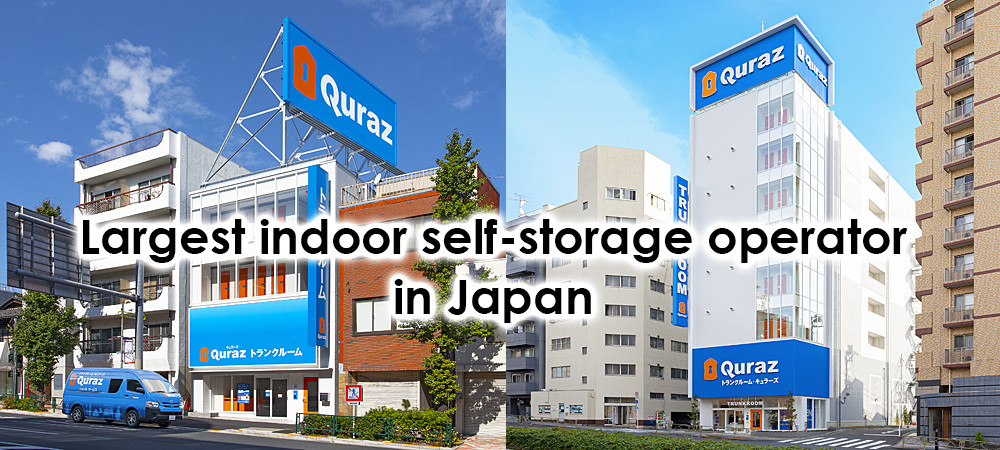
He joined Quraz as part of the five-person founding team in 2001, when the company had a single asset in Tokyo. Today, they run 71 facilities, manage more than 40,000 units, employ around 200 people, and hold the title of largest self-storage operator in Japan by both revenue and unit count, placing it in the top three across Asia.
That journey took 25 years. For a significant stretch of it, the biggest constraint on growth wasn't real estate or capital. It was software.
The ability to do something like this, your flexibility in a cloud environment with APIs that we could just connect to and use as we wish, was a massive factor in selection. – Yasuo Hagiwara, Quraz
The limits of “Good Enough”
The early phase of Quraz's growth, roughly 2005 to 2015, was when technology problems started compounding. Moving off spreadsheets, evaluating CRMs and ERPs, adopting an off-the-shelf solution called Rent Plus: each step forward brought new friction.
"Within a few years we saw its limitations very quickly," Hagiwara recalls. The core issue wasn't functionality in isolation. It was fit.
- Rent Plus wasn't built for the Japanese market
- Language requirements created operational complexity
- Tax structures required heavy customisation
- Payment integrations were difficult to support
- Customisation created its own cascade of problems
The logical next move was to build something in-house. They developed an ERP/CRM called Nexus on the Microsoft Dynamics framework: a real investment, staffed by a small internal development team, running the operations of a growing multi-site portfolio.
For a while, it worked.
Download the ultimate Self Storage e-book
Everything you need to know about setting up your self-storage facility.
The hidden cost of owning your own stack
Custom systems have a way of ageing into fragility. The knowledge required to maintain Nexus concentrated in the hands of a small group of people, and that dependency quietly became a business risk. If those people left, invoicing could go down.
And at a certain point, something did. One system went down, not for long, but long enough to make the conversation unavoidable. For any business billing thousands of customers, that kind of failure doesn't need to be dramatic to force a decision. It just needs to happen once.
Fundamentally we're not a technology company. We're a self-storage company, a real estate company. Maintaining employees with that skillset to manage a completely bespoke system was becoming more and more challenging. – Yasuo Hagiwara
Looking outward wasn't just about fixing a problem. It was about removing a structural dependency that had been building for over a decade.
Why flexibility mattered more than features
When they evaluated Storeganise, the decisive factor wasn't a feature list. It was architecture.
Quraz's use case is deliberately unusual. Rather than adopting Storeganise as the primary interface their team interacts with, they built a custom front-end application on top of it.
Storeganise runs as the operational engine underneath, handling the logic, data, and processes, while their own developers built the interface their staff and systems actually touch.
That model only works if the underlying platform is genuinely open. Most traditional self-storage software isn't.
Quraz effectively outsourced the burden of maintaining core operational infrastructure to a team whose entire job is to maintain and improve it, while keeping the in-house capability to build on top however they need.
What “It Just Works” actually means
Three years on, Quraz contacts Storeganise support once or twice a year. Not because they have no questions, because nothing breaks.
"It's just on in the background, reliable. Which is kind of all you want from a system." – Yasuo Hagiwara
For a COO managing 71 assets, 200 employees, and the operational complexity of Japan's largest self-storage portfolio, that's not a small thing.
Before, the business depended on a handful of specialists to keep the lights on. Now, core operational infrastructure runs quietly and predictably, and the internal team focuses on what actually differentiates Quraz.
What's next: Staying on the curve
Hagiwara has assembled what he calls an AI SWAT team: staff across the business who are curious and proactive about AI applications, working on productivity and operational optimisation projects. Some of those projects may eventually face customers.
He's also been building with Claude Code himself, working through the Anthropic Academy to keep up-to-date on AI capabilities.
"I felt the empowerment of using AI to prototype in minutes and hours. It's important for me in my role to understand capabilities, so that I can have ideas about how this might be adopted more broadly." – Yasuo Hagiwara
The approach Quraz has taken throughout holds. Stay on the curve without becoming a technology company. Build on platforms that are built to be built on. Keep enough in-house capability to move fast when it matters, without carrying the full weight of owning a stack that isn't your core business.
After 25 years, they know better than most what happens when you try to do the opposite.
Conclusion: Built to be built On
"The ability to do something like this, your flexibility in a cloud environment with APIs that we could just connect to and use as we wish, was a massive factor in selection." – Yasuo Hagiwara
Quraz Self Storage operates 71 facilities across Japan with more than 40,000 units under management. Storeganise powers their core operational infrastructure via API, with a custom front-end built on top.
The key takeaway? You do not need to own every part of your technology stack to stay innovative. They chose a platform flexible enough to support their own systems, reliable enough to run quietly in the background, and open enough to keep building around as the business evolves.